Monday, April 21, 2014

Table Talk

by Sara Etgen-Baker

Although I was just a small girl during the late 50s and early 60s, I was keenly aware of the rhythmic cadence of my neighborhood. Every morning shortly after 7 a.m., my father and the other men in my neighborhood vacated their homes and boarded their pickup trucks. And, like clockwork, they departed from the neighborhood leaving behind their wives and children. Once the men were gone for the day, the women vacated their homes and by 8 a.m. gathered around one another’s kitchen tables for what the women called their table talk.

And because I was one of only two girls in the immediate neighborhood, I accompanied my mother when she attended these seemingly clandestine meetings. At each meeting, I pulled up a stool; sat next to my mother; and breathed in the smell of dark, rich black coffee as it wafted through the air of their cramped, cracker box kitchens. I sat motionless and silent, sipping on hot cocoa and listening while the women drank their coffee, told their stories, served up their secrets, shared their struggles, and offered up their compassion and humanity. Throughout the years, they cultivated a culture of trust that allowed them to feel comfortable and supportive as they shared some of their most intimate truths.


Although the times were changing all around them, this trust held them together; and they continued telling their stories. Their stories—as rich and robust as their coffee—were full of strength, insight, and wisdom. From their stories, I gleaned an unbelievable amount of perspective that I carried with me as I ventured off to college and entered womanhood. No matter what situation or struggle I encountered, I could remember one of those table talk stories and know what to do.

So what happened to those table talks? I suppose they disappeared as my generation of women entered the workforce, began our careers, and started our families. But the absence of table talks created a void—a void that up until recently hadn’t been filled.

Then in 1997 Susan Witting-Albert founded the Story Circle Network—an organization dedicated to helping women once again share the stories of their lives. Seventeen years later, women—thirsty for stories—gathered for this year’s SCN conference in Austin, Texas. Women from different cultures and generations sat around tables, listened to one another, and shared their writings and their stories.

After the conference I realized one thing: Women crave stories. We yearn to tell our stories; we need to fill the void; we must to return to our table talk. The Story Circle Network cultivates a culture of trust and, in so doing, fills that void and allows us to gather together and once again share our secrets and hidden truths. I am delighted to be a part of a tremendous organization and legacy.

Wednesday, April 16, 2014

Soul Making Keats Literary Competition

In the fall of 2013 I entered the Soul Making Keats Literary Competition.  I took first prize in the memoir vignette category.  Here's the certificate I received...I'm so thrilled to hang this on my writing wall!  Oh, the $100 check was nice, too!


Thursday, March 13, 2014

Another Toy Story

A sweet memory of my father...just had to share!

ANOTHER TOY STORY

By Sara Etgen-Baker

            “I can’t find Tiny.”  I tugged on mother’s arm.  “She’s lost.”
            “Did you look in your closet?”  Mother peeked around the corner of her newspaper.  “Look under your bed.”
            “I did, Mama.  She’s nowhere to be found!”
            “When did you last see her?” 
            “At school; I took her to school with me and….”  My heart sank to my toes.  “I must’ve left her there.  We’ve got to get her.  Pleeeease!”
            “Sweetie, school’s closed till Monday; there’s no way we can get her.”
            “But it’s dark there; she’ll be lonely; she’s probably scared and won’t be able to sleep without me.” 
            “She’ll be fine sweetie.  Scurry off to bed now.” 
            But in the middle of the night when I discovered that my Tiny Tears doll wasn’t with me, I stumbled through the dark to my parent’s bedroom and pulled on my father’s pajama sleeve. 
 “What’s wrong, Sweetie Pie.”
            “I miss Tiny.” 
He sat up in bed.  “Where is she?”
“She’s at school; she misses me; and she’s scared.”   
            “Okay Sweetie Pie; we’ll check on her.”  He picked me up, carried me outside, and placed me in the front seat of his truck. 
            We drove by my school peering into its windows.  “I see her.”  He turned toward me and patted me on the shoulder.  “She’s okay; she’s sleeping.”
            “I can’t see her daddy.  Are you sure?”
            “Yes, but let’s double check.”  He backed the bed of his truck up next to the building, stood me up in the bed of the truck, grabbed a flashlight, and cast a stream of light into the window.  “You see her now?”
            “Yes, Daddy!  I see her.  She’s okay!”
            “She’ll miss you; but see the other toys?  Tiny won’t be lonely.”
            It’s a sweet childhood memory of my father.  His selfless actions taught me that love is patient, kind, and protective.  And because he didn’t just dismiss my emotions, he validated the worthiness of my childhood emotions.  His validation was critical, for I didn’t feel abandoned, and I learned to both trust and embrace my emotions first as a child and later as an adult.

Sunday, March 9, 2014

Dillehay Crossing--Chapter 1

Just wanted to share the initial chapter of my novel, Dillehay Crossing.  The chapter is still rough in places, but I'm falling in love with the characters and the premise behind the novel.  I'm only sharing part of Chapter 1 right now...to keep you reading.  Enjoy!

DILLEHAY CROSSING
Chapter 1 
            Abi donned her running clothes, laced up her running shoes, and rushed downstairs.  The lavender early morning lit her way as she approached the gravel trails that meandered along the creek’s edge.  At first her stride was short and her pace slow; but as her heart pounded harder, the blood in her body heated, and her tight muscles loosened.  Abi lengthened her stride and quickened her pace.  Beads of sweat trickled down her forehead, stung her eyes, and blurred her vision.  So, when the trail turned sharply, Abi didn’t see the broken tree branches in front of her. 

She stumbled and landed face first in some underbrush.   She stood up, wiped the dirt and sweat from her face, and caught a glimpse of something just around the bend.   What are those old structures off in the distance?  I don’t think I’ve ever seen them before.  She shook off her fall and resumed her run, curiosity and adrenalin surging through her body.  Abi ran across a narrow, shallow bend at Dillehay Crossing where an old dilapidated ranch house, Texas wind wheel, and crumbling red barn came into view. 

  She approached the property and ventured inside the decrepit red barn.  She ran her fingers over a rusty, turn-of-the-century tractor.  Who once lived in this ranch house and drove this old tractor?  Abi strolled up the dirt and gravel walkway that led toward the discolored, broken-down ranch house.  The crumbling and sagging structure beckoned her inside; so, she crept up the rickety steps onto the front porch.  Using her shoulder, Abi shoved open the front door and found that—although the wooden house was decaying—the floors were not rotten and actually looked sturdy enough to bear her weight.

She entered the house, turned right, and discovered the parlor had a fireplace with an adjoining kitchen and an antiquated four-hole wood cook stove.  Abi picked up the empty cast iron cooking pot from the stove and pretended to stir its contents.  How long have you been waiting for the woman of the house to return? 

Abi retraced her steps then made an immediate left toward the stairs.  At the base of the steps, Abi saw her—the cloudy figure of a woman.  Abi’s eyes traveled up looking for some semblance of a face, but smoke—gray smoke—filled in the places where the woman’s nose, mouth, and eyes were supposed to be.  The woman turned and floated up the stairs, the morning light passing through her like sunlight through smoke.  Abi followed her.  Did the woman know Abi was there?   

At the top of the stairs, the woman disappeared as she faded through one of the bedroom doors.  A young woman’s frantic voice begged from behind the wall.  “Hurry!  Fetch the doctor right away!  Something’s terribly wrong!”  The woman’s voice made Abi’s skin crawl and the hairs on her neck bristle.

She jumped back, reversed her course, and scurried back through the house.    Once outside, Abi retraced her steps and ran back down the dirt and gravel road.  She raced across the shallow end of Dillehay Crossing and ran along the creek’s edge until her own front porch was in sight.  She stopped and caught her breath.  Questions whirled through her mind.  Who was the woman I saw?  Whose voice did I hear?  Just who were the ranchers who had once cared for the livestock and land on the other side of Dillehay Crossing?  Were they in any way related to her husband and the Mason family?  Why did they leave?  Hmmm.  I’ll have to ask Howie.  Will he believe me if I tell him about the woman I saw.  Well, maybe I shouldn’t tell him about her just yet.  To be continued......

Wednesday, February 26, 2014

Green Stamps in Your Attic

Once upon a time in a land far, far away, women in this country hoarded S&H Green Stamps.  The women in my family and in my neighborhood often gathered at their kitchen or dining room tables and socialized while they licked their stamps, placed them in booklets, saved them, and eventually redeemed them at a local redemption center.  So, I'm sharing a memoir with you about my own experience with Green Stamps.  Enjoy! 

A Culinary Treasure By Sara Etgen-Baker


My mother’s rectangular-shaped kitchen was tiny—no more than 7 feet long and 5 feet wide—which was to be expected since the house itself was small. When my parents moved into the two-bedroom house in 1952, the kitchen—designed primarily for functionality—came equipped with a moderate-sized refrigerator, a full-size gas range with stove, but annoyingly little counter and storage space. The storage was so sparse that my mother stored her pots and pans in the oven overnight, removing them the next morning when she prepared breakfast.

Although I learned to cook standing alongside her, I often complained about her cramped, cracker box kitchen. When I did, Mother reminded me, “You know when I was a young girl during the Depression, I helped my mother cook on a wood stove that was so old it had holes in it. So when your dad and I moved into this house, I was thrilled! What more do I need? I have a stove, a refrigerator, pots, pans, knives, and serving spoons; everything else is optional. Don’t be so fussy!”

Even without a dishwasher or disposal, Mother was content having just a sink, which was white porcelain enamel-covered cast iron—quite popular in the 50s. Despite its apparent practicality, her kitchen was somewhat modern and stylish with its white metal cabinets, black accents, bright yellow walls, and work surfaces topped with ‘Softglow’ Formica.

After dinner, I’d hand wash the dishes in that sink, leaving them to dry overnight; then, I’d join my mother, aunt, and grandmother as they crowded around my mother’s tiny, cracked-ice Formica table. They’d dump all their S&H Green Stamps onto the table, sort them by denomination, lick them, and then place the stamps on the grid pages of the booklets that the supermarket gave away.


Like most women in the 50s and early 60s, my mother, aunt, and grandmother didn’t work outside the home. So, they diligently collected and redeemed S&H Green Stamps, giving them a means of obtaining items they wanted or needed independent of their husbands. They even helped one another by giving or trading filled stamp books. My grandmother often gave my mother filled stamp books so my mother could get small appliances she needed. Even with my grandmother’s help, my mother saved for nearly two years to have 4 ½ books of Green Stamps—enough to redeem for a Sunbeam electric waffle maker and a Sunbeam Mixmaster.

I accompanied my mother the summer afternoon when she went to the Redemption Center to trade her Green Stamps for the electric appliances. Mother filled out a paper order form; submitted it to the cashier; and then waited for a stockroom clerk to check the store’s inventory to see if the item was available. While she waited, I passed the time browsing through the store, imagining what I’d choose if I had my own Green Stamps.

Then I saw it—The Betty Crocker Cookbook for Boys and Girls—aptly described as a great cookbook for boys and girls, introducing them to basic cooking techniques and utensils and includes simple recipes for salads, breads, main dishes, desserts, and snacks. When I flipped through the recipes, drawings, and photographs, I immediately knew that I simply had to have that cookbook. Even though the cookbook cost only half a book of Green Stamps, I also knew better than to out-and-out ask Mother to give me any of her priceless Green Stamps!

So as we were leaving, I paused at the cookbook display and asked, “Mama, have you seen this cookbook? It’s just perfect for me! Could I do extra chores to earn enough Green Stamps to buy it? Please, Mama, pleeeese!”

“Well,” she hesitated, “I suppose so. You’ll have to be responsible for keeping track of your own stamps and putting them in the booklets. Remember, though, that once school starts, you won’t be able to do as many extra chores. School comes first.”

So, I spent the entire summer doing everything extra that I could—ironing my father’s shirts, folding clothes, vacuuming my bedroom, dusting, and even cleaning the bathroom. I was ecstatic the day I hand-polished my grandmother’s silver, and she gave me almost two-page’s worth of Green Stamps. At some point, even the neighbor ladies helped by giving me Green Stamps for polishing their shoes, ironing their clothes, washing their dishes, dusting their houses, and running errands to the local market. By summer’s end, though, I was four pages short of having the half book of Green Stamps that I needed.


Once school started, I did as I promised my mother, dedicating myself to my school work. So months passed, and I still didn’t have enough stamps to purchase my cookbook. Then a few days before Christmas, my father asked me, “Sweetie Pie, how many more Green Stamps do you need for your cookbook?”


“Now I think I need just three more pages. Why? Do you have an errand or chore I can do?”

“Just curious,” he replied. “Tell you what—grab your stamps and hop in the pickup.”

As I hoisted myself onto the seat, I noticed an envelope full of Green Stamps. When I looked at my father, he chuckled and said, “My gas station started giving Green Stamps; so I’ve been secretly savin’ these just for you as part of your Christmas present. Merry Christmas, Sweetie Pie!”

With that, we drove to the Redemption Center where I filled in the paper order form, and then anxiously waited while the stockroom clerk checked the store’s inventory. Eventually he returned with my cookbook. After the purchase, my father inscribed these words on the inside cover: “May this, your first cookbook, help you to learn to love cooking.” Love, Daddy, Christmas 1961.

At home, we flipped through the pages until my father decided he wanted the Eskimo Igloo Cake described on page 14. So on that Christmas and so many Christmases and Father’s Days thereafter, I made the Eskimo Igloo Cake just for my father—our very own father-daughter tradition.

Even now—50+ years later—I miss baking his special cake in my mother’s tiny cracker box kitchen. I miss saving, licking, and sharing Green Stamps with family and friends. I also miss cooking in close proximity to my mother. Sometimes, though, as I putter around my own kitchen, I can feel her presence and am grateful for her and the kitchen traditions she gave me.
Here's a link to a great article about S&H Green Stamps:
http://www.straightdope.com/columns/read/1940/whatever-happened-to-green-stamps

Wednesday, February 5, 2014

Ties to the Past


TIES TO THE PAST by Sara Etgen-Baker

When I think of aprons, the first image that comes to mind is one of my mother or my grandmother wearing an apron while cooking for the family. I realize that image is a bit old fashioned; yet, there was a time—and not so long ago—when every woman proudly wore her apron. Aprons were a given—a part of the feminine culture—for they were synonymous with woman’s domesticity and her wisdom.
I remember that my mother and both of my grandmothers put on their aprons as soon as they entered their kitchens and wore them throughout the day as they cooked, completed daily chores, and selflessly cared for their families. In fact, all three ladies made their own aprons and expressed their personalities and individuality with them. As I recall, my Grandmother Stainbrook made bright colored, bib-style aprons that tied in the back with deep pockets. My other grandmother preferred delicate, pastel colored half aprons that complemented her outfits and accentuated her tiny waist.

My mother—a stout and practical woman—used bib-style aprons for daily use that she created from fabric remnants. She generally wore her bib-style apron to protect the dress underneath saving her fancy half aprons with ribbon, lace, and appliqués for holidays and entertaining.

Mother used her bib apron for almost everything—dusting furniture, drying my tears, picking up hot pans from the oven, wiping the sweat from her brow, bringing in plums that had fallen from the trees, and carrying my ailing kitten from the backyard into the house. Her bib apron pockets were always full and housed such items as clothespins, handkerchiefs, band aids, rubber bands, loose change, Life Savers candy, my jacks, and my brother’s marbles.
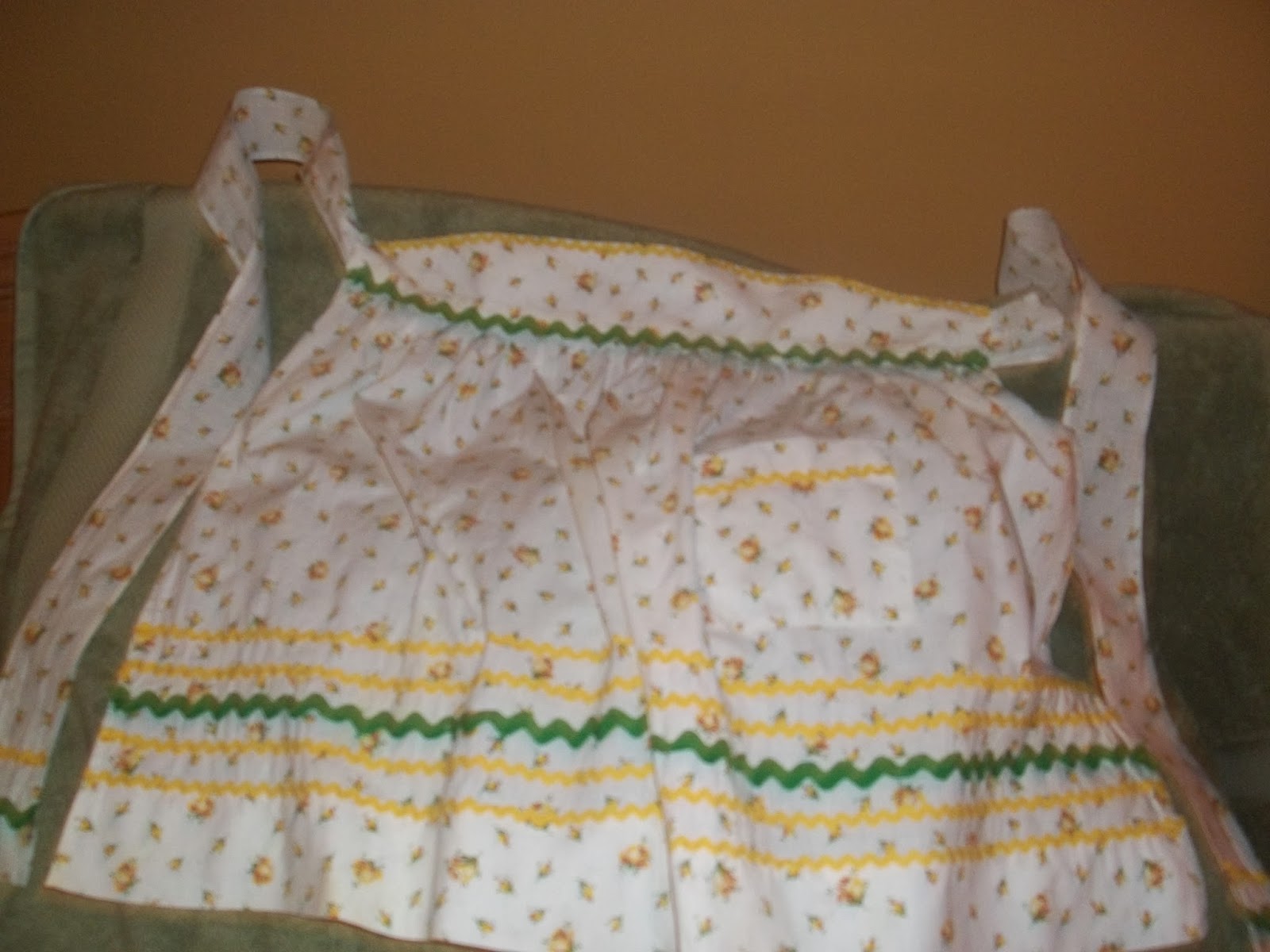
In fact, the first garment I ever made was a half apron—my 8th grade sewing project in Home Economics at Austin Junior High in 1963. After buying the apron pattern for 65 cents, mother didn’t have enough money to purchase additional fabric. So, I was forced into using the remnants of kitchen curtain material that my mother had purchased at J.C. Penney—a white fabric covered in small yellow roses.
During that first semester’s apron project, I learned basic sewing how-to’s, such as cutting out a pattern and correctly pinning it to the fabric; properly cutting the fabric; basting a garment; threading the sewing machine; using the foot pedal or knee pedal; gathering skirt material and attaching it to a waistband; making and attaching pockets; and hemming a garment.
At semester’s end, I was overjoyed when I completed my apron; yet, I must confess that I felt a wee bit like Scarlett O’Hara in Gone with the Wind, for—like Scarlet—I looked as if I were wearing a curtain. Perhaps my adding the green and yellow rickrack to the waistband, pockets, and hem gave my apron that just hung in the window appearance. Who knows! Still, I proudly wore my apron second semester whenever we cooked or completed chores in home economics class.
In 1963 I understood and accepted that aprons were a part of being a wise homemaker. However, sometime in the late 60s aprons took a wrong turn, as they became symbols of feminine oppression. As the women’s movement took hold, aprons seemingly disappeared from favor and the feminine landscape. I, too, cast off my apron as I left home, attended college, and joined the workforce.
Now, I find myself fascinated with aprons, for they reflect how my foremothers saw themselves; how they functioned in society; and how culture viewed them. Each apron intrigues me, for I see that each one has a unique story to tell with its own wisdom and ties to the past.    
 

Sunday, February 2, 2014

The Art of Storytelling.....

Just learned that one of my favorite writer's exchanges will cease to exist come July 2014.  Until then, we writers can comment on the upcoming topics.  What follows is a link to my response to this month's prompt:  "What's the Worst Mistake You Can Make as a Writer?"  Enjoy my response and the response of others:  http://tiny-lights.com/searchlights.php?id=1402#1404